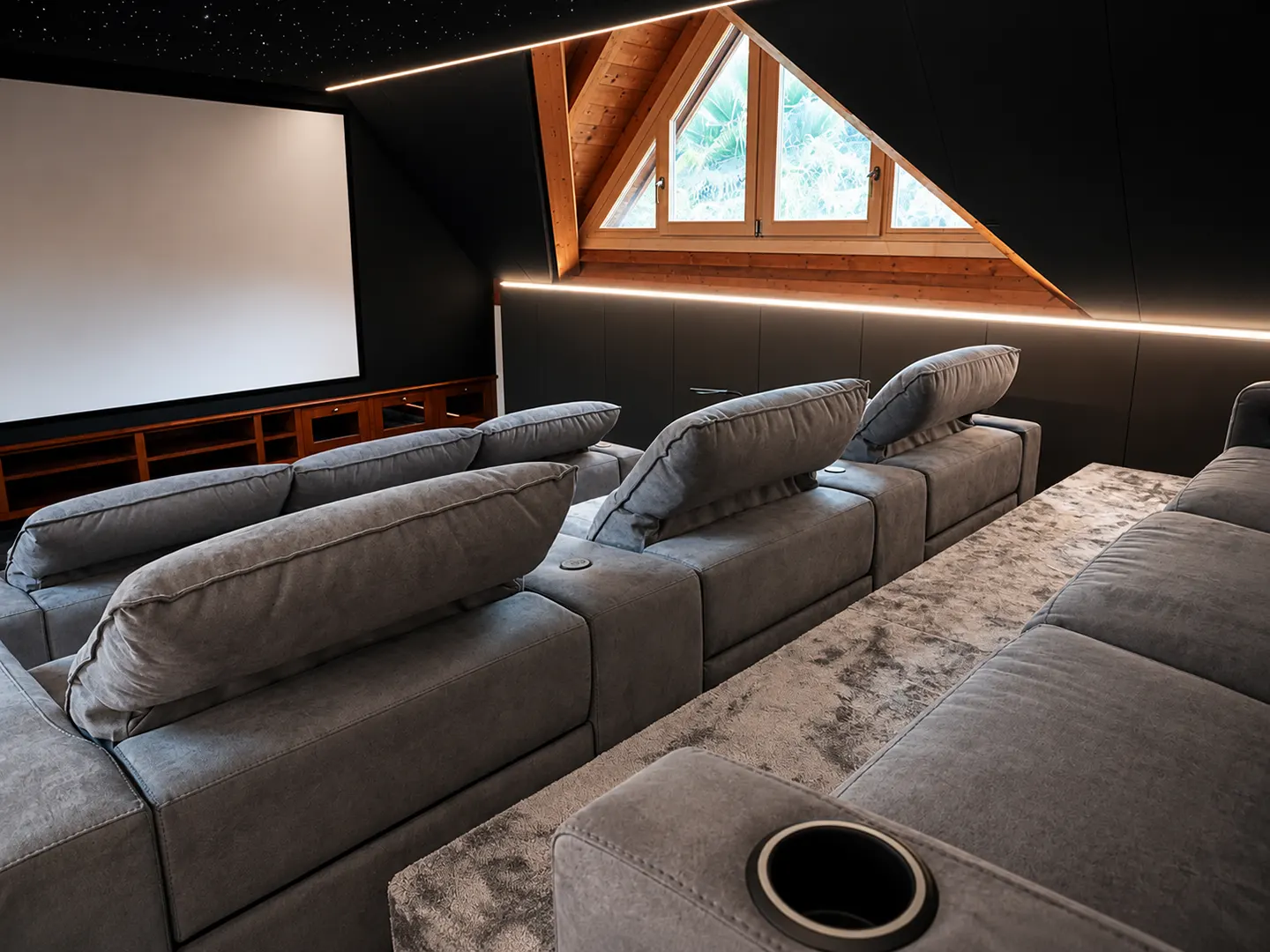
Italian Home Cinema Seating
Most people fall in love with a private cinema from the seat. They see a row of reclining chairs in soft leather, the light low, and they think: that is what I want in my house. It is a good instinct, because the seat is the only part of a cinema you actually touch, for two hours at a time. It is also the part that quietly decides the rest of the room.
We know this from experience. An architect in the Caribbean came to us looking for Italian home cinema seating for a client’s house. He found the chairs. What he took away was a designed room, because once you know where a seat has to be, you know where the screen has to be, where the speakers have to be, and how big the room has to be.
The answer in brief
Italian home cinema seating is made to measure, not picked from a catalogue: frames, foams, leathers and stitching are built by specialist Italian workshops, and the chair is specified as part of the room, not after it. Ultra Experience is an architect-led Italian company based in Bassano del Grappa, near Venice, and a CEDIA member: we design and build turnkey private cinemas, and we ship and install seating and rooms internationally, with our own team on site.
What makes Italian seating different
The difference is not a logo on the headrest. It is a way of building that survives in a handful of workshops in the north of Italy, where furniture has been made by hand for generations and the same people still cut, sew and upholster.
The frame. A cinema recliner carries a motor, a moving footrest and a moving backrest. What holds all of that is a wooden or steel frame that nobody will ever see. In a well made chair it is oversized on purpose, because the motor multiplies every weakness over thousands of cycles.
The foams. Comfort in the first ten minutes is easy. Comfort in the second hour is a matter of layered foams with different densities: firm where the body loads, soft where it touches. This is where cheap seating gives itself away, and it gives itself away late.
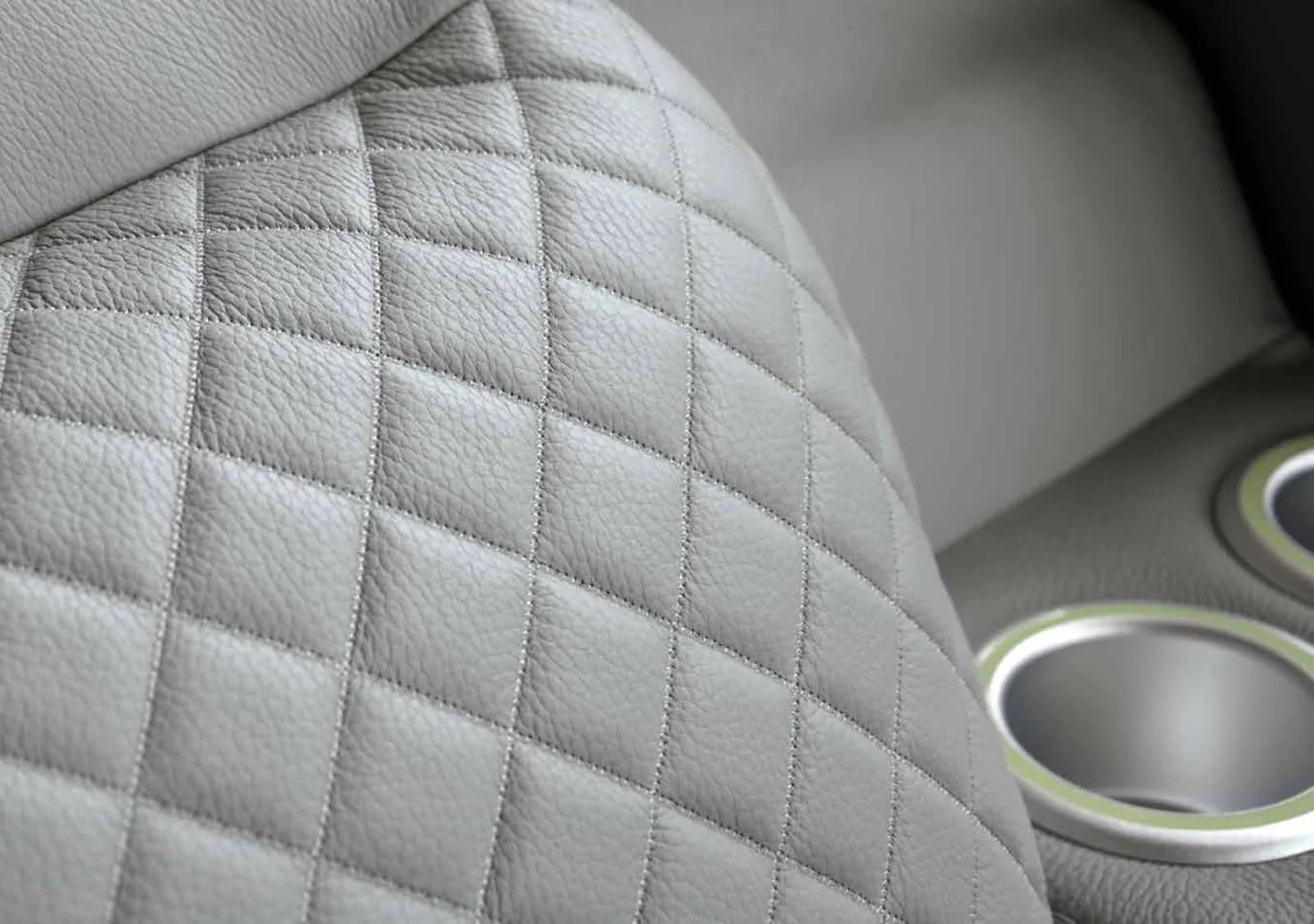
The hide. Italian tanneries still work full grain leather that ages instead of wearing out. On a chair that lives in the dark, the finish matters as much as the grain: a glossy hide throws back the light from the screen and sits in the corner of your eye all evening. We choose matt finishes for a reason.
The stitching. Hand stitched seams, piping, the way a headrest is closed: these are the details you notice at arm’s length, and they are the reason a room feels finished rather than furnished.
Materials that have to work in the dark
A cinema is an optical instrument. Everything in it either absorbs light or gives it back, and the seats are the largest soft surface in the room after the walls.
Leather is the classic: durable, easy to clean, cool to the touch, and reflective. In a dedicated cinema we use it in dark, matt finishes.
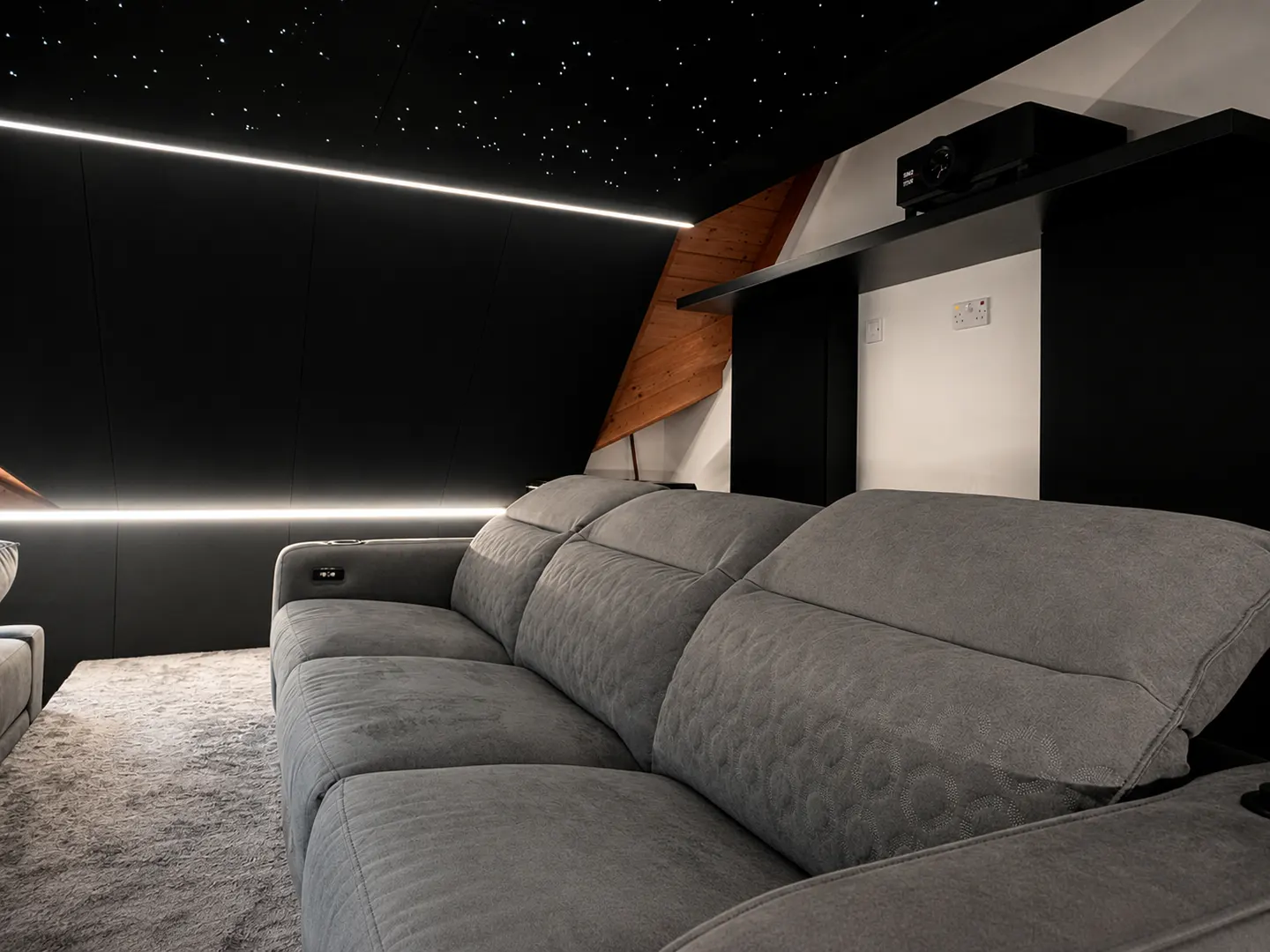
Techno nabuk is our answer to demanding climates and heavy use. In the private cinema our team delivered in Kenya, the nine motorized recliners are upholstered in techno nabuk: it stays pleasant to the touch in heat and humidity, hour after hour, and it does not reflect the screen.
Fabric absorbs more sound than leather and can be the right choice acoustically, especially in a small room where the treatment budget is tight.
There is no best material. There is the right material for that room, that climate and that use, and that is a design decision, not a shopping decision.
A seat is not a room
This is the part that catalogues never mention, and it is where most self-designed cinemas go wrong.
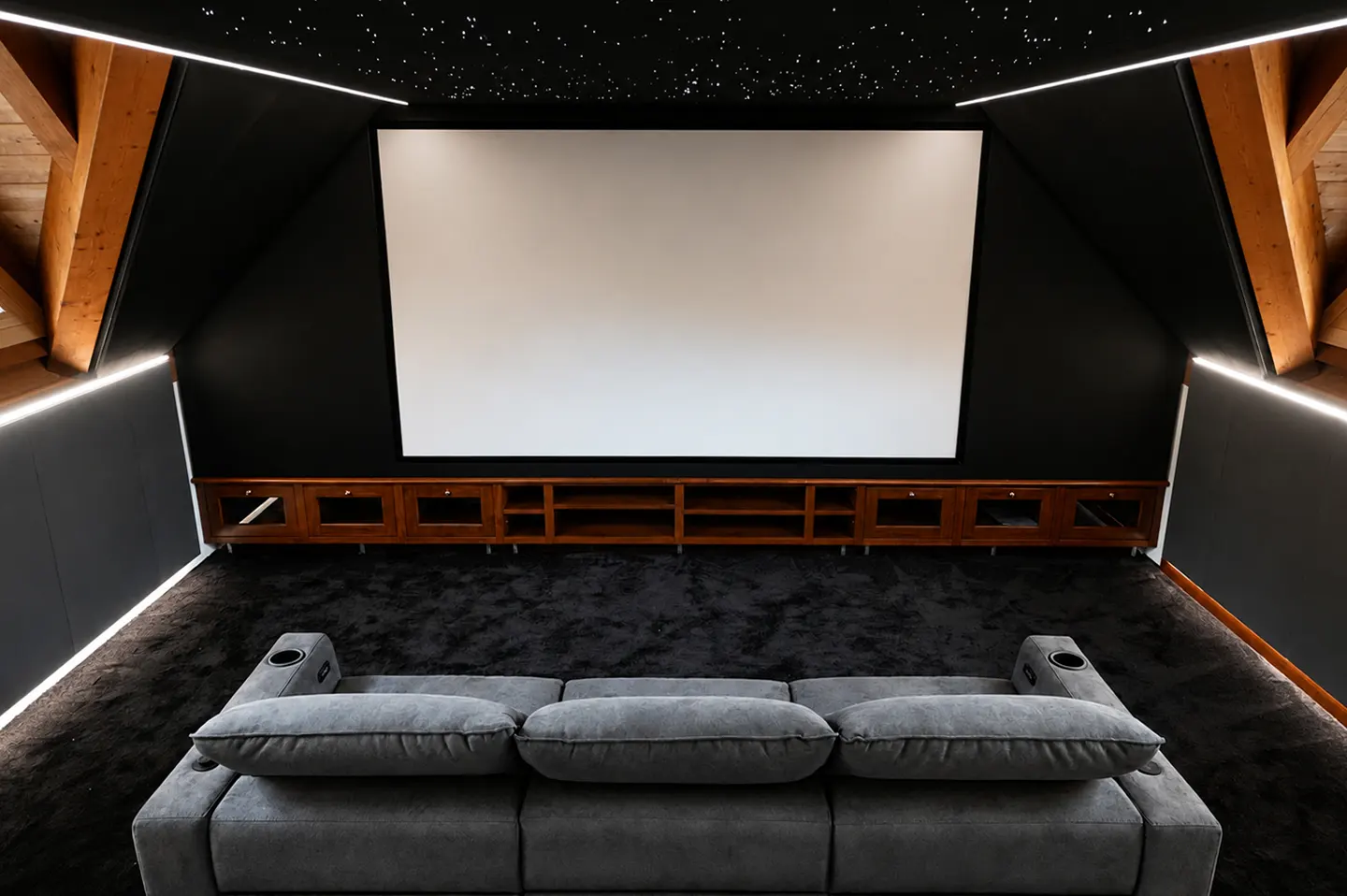
The distance is set by the image, not by the sofa. For a 4K image, the central seat works well at roughly one and a half to two times the screen width. Choose the chair first and you have chosen the screen size, whether you meant to or not.
The second row only sees if it is higher. A riser is not a decorative touch: without it, row two watches the heads of row one. Typical heights run between 25 and 40 centimetres, but the real number comes from the sight line: screen height, seat recline, and the ceiling, which still has to leave room for the overhead speakers of a Dolby Atmos layout.
A recliner is twice the chair it looks. Fully open, a motorized seat approaches two metres of footprint. Row spacing has to allow for reclining and for walking past. This is where the third row quietly disappears from a plan.
Never against the back wall. Bass builds up along the boundaries: a seat pushed against the rear wall gets a thick, muddled sound. How much clearance you need is a calculation on the room dimensions, not a feeling.
Seats change the acoustics. A row of fabric chairs absorbs the mid and high range very differently from a leather sofa, which reflects. Acoustic treatment is calculated with the seating in place. Change the chairs after the room is finished and you have changed the sound of the room.
Our home cinema design guide explains how these decisions fit together, from the geometry of the room to the light and the materials.
Made to measure, and delivered anywhere
Made to measure means what it says: number of seats, width, recline angle, headrest height, arm width, colour, stitching, integrated tables, cup holders, lighting under the arms, power for a laptop. It also means the layout: how many rows, how far apart, on which riser.
We work the same way outside Italy. The materials leave in a container and our own team installs on site: in Kenya a 9.2.4 Dolby Atmos private cinema was assembled in ten days, seating included. In the Caribbean the seating went first and the room followed. Distance is a logistics problem, and we have solved it more than once.
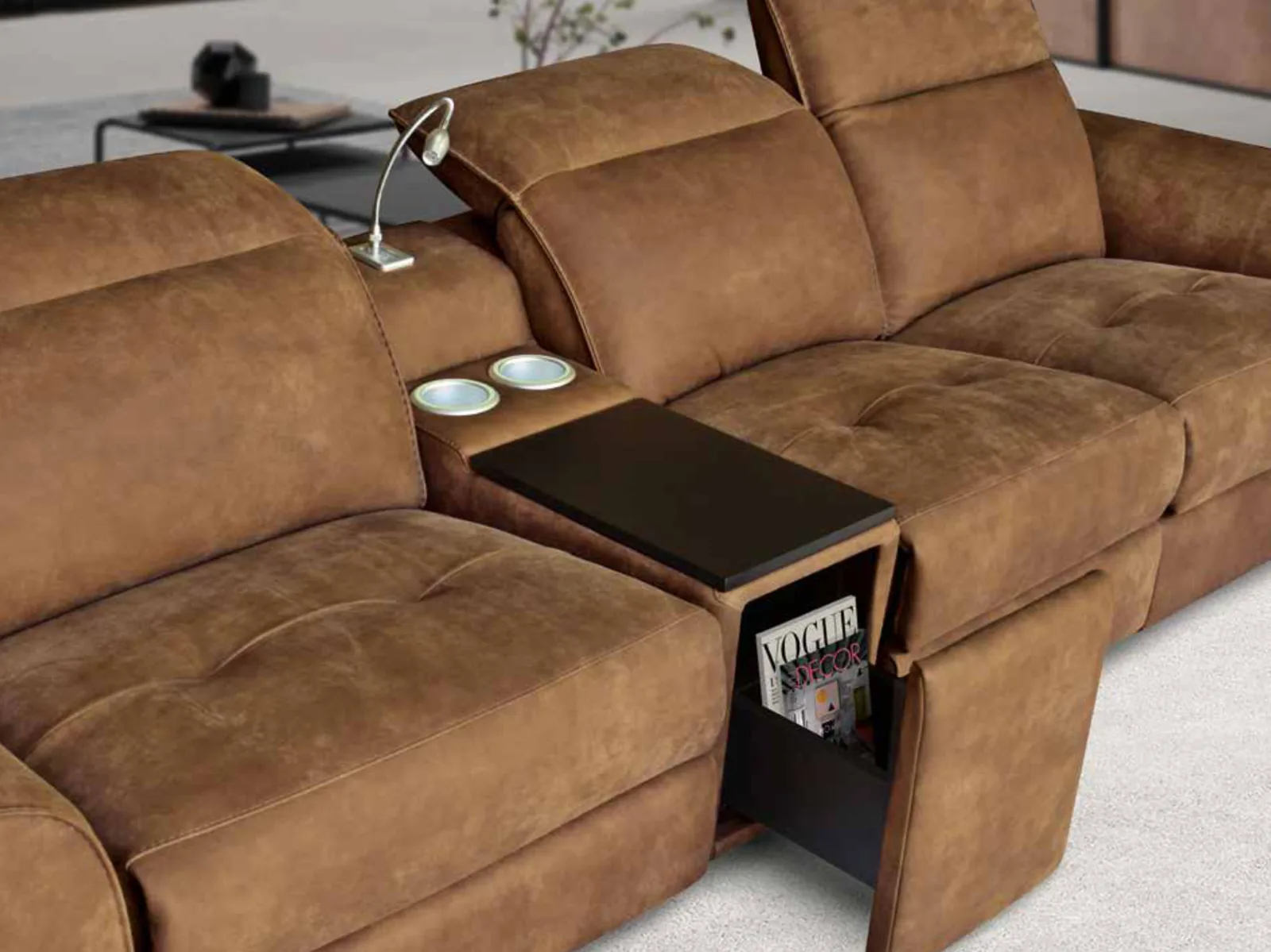
We are members of CEDIA, the international association of home technology professionals, and we follow the industry standards on sight lines, ergonomics and layout. It is the difference between furnishing a room and designing a cinema.
For architects and interior designers
If you are specifying seating for a client, you already know the awkward part: the chair arrives, and then the room has to accommodate it. We work the other way round, and we are used to working inside someone else’s project.
You keep the client and the design language. We bring the geometry, the acoustic layout, the seating specification and the installation, and we deliver a room that behaves the way the drawings promised. Ask us for the technical documentation: sight line sections, row spacing, riser heights and the acoustic implications of each upholstery choice.
Come and sit in it
Nothing on this page will convince you as well as twenty minutes in a real room. Our demo cinema in Bassano del Grappa, near Venice, is a complete private cinema with calibrated projection and immersive sound, and the seats are the ones we talk about here.
Call +39 0445 1911502 or write to us here. We work in English, and we deliver projects worldwide.