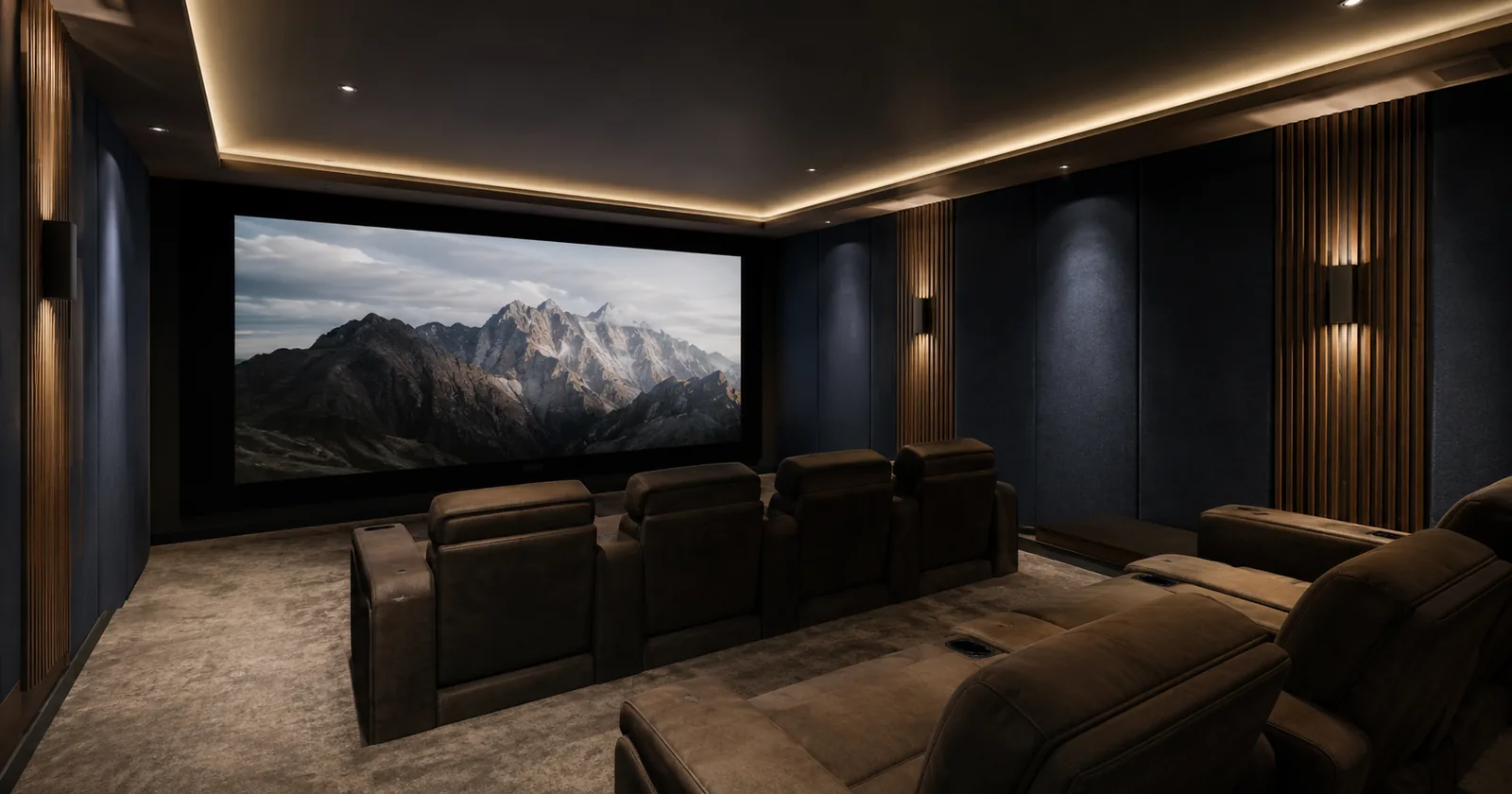
Italian Home Cinema Design
Italy has never really exported products. It exports a way of seeing: the conviction that how a thing is made and how it makes you feel are the same question. Italian home cinema design applies that conviction to the most emotional room a residence can hold, the private cinema. Not a dark room filled with equipment, but a piece of architecture where concept, materials, seating, color and engineering are decided by one hand, for one purpose. As an architect who has spent years designing and building these rooms (and installing every cable in them), I can tell you where the difference truly lives. It is rarely where catalogs say it is.
The answer in brief
Italian home cinema design means treating a private cinema as a work of architecture, not a collection of devices: a single design vision that unites room geometry, acoustic engineering, Italian materials and craftsmanship, seating, color and light. Ultra Experience is an architect-led Italian company based in Bassano del Grappa, near Venice, and a CEDIA member: it designs and builds turnkey private cinemas, home theaters and screening rooms for residences in Italy and worldwide, shipping materials and its own installation team to the project site.
What Italian home cinema design really means
In most of the world, a home theater is assembled: a screen is bought, speakers are added, seats are ordered, and an installer connects everything. The result can be technically correct and still feel like a showroom.
The Italian tradition works in the opposite direction. First comes il progetto, the project in the architectural sense: the geometry of the room, the proportions, the sightlines, the way sound and light will behave, the way nine people or three will inhabit the space for two hours without noticing a single technical object. Only then are components chosen, because by then the room itself has decided what it needs.
This is why the concept stage matters more than any purchase that follows. A cinema room has one author or it has none: when the interior designer, the acoustician and the AV installer each optimize their own corner, the corners never meet. In our projects the architect leads all three conversations. It is also the reason architects and interior designers like working with us: we speak their language first, and the language of decibels second.
Materials that are beautiful because they work
The most misunderstood part of a luxury home cinema is the surface you touch and see. In an Italian project, materials are never decoration laid over technology; every surface has an acoustic job and an aesthetic one, and it must do both.
- Fabrics absorb. Acoustic textiles on walls hide treatment where the room needs absorption, and give the room its warmth and depth.
- Wood structures and reflects, in measured doses. A wooden detail is placed where a reflection is welcome, not where a catalog suggests.
- Leather and technical hides reflect sound and age beautifully. That is a design decision with acoustic consequences: a room of leather seats behaves differently from a room of fabric ones, and the treatment must know it in advance.
- Matte finishes everywhere the projector’s light can reach. A glossy surface near the screen is a second, unwanted image; the room must disappear when the lights dim.
For a private cinema we completed in Kenya, the nine motorized armchairs were upholstered in techno nabuk, chosen not from a swatch book but from the project itself: a material pleasant to the touch after three hours of film, in a demanding climate. That is what “made in Italy” means in practice. The material serves the experience, and the beauty is a consequence.
Seating: Italian craftsmanship, engineered position
The armchair is where the whole project is finally judged, because it is where the client lives. Italian seating brings the craftsmanship: motorized reclining, stitching, materials that improve with age. But here is what no furniture catalog will tell you: where the seat stands matters as much as what the seat is.
The distance from the screen is calculated on the image width. The second row sees only if it rises on a platform, and the platform’s height is a sightline calculation, not a guess. A high seatback in the wrong position shades the surround speakers exactly at ear height. A row of open recliners needs nearly two meters of depth, and suddenly the third row a client dreamed of no longer fits. Or it fits, if the room had been designed for it from day one.
Seating, screen, acoustics and room are one system. This is the heart of the Italian approach: we do not sell you chairs. We design the room the chairs belong to.
Color and light: where taste becomes technique
Ask anyone to imagine an elegant private cinema and they will imagine color: deep reds, midnight blues, warm neutrals. They are right, but for a reason they may not suspect. In a projection room, color is an optical instrument. Light bouncing from a saturated or pale wall contaminates the image on screen; the wrong ceiling tone lifts the black level of every scene. Dark, desaturated palettes are not a fashion, they are calibration by architecture. The craft lies in making a technically dark room feel warm and precious rather than funereal, and this is where Italian interior culture earns its reputation.
Light follows the same logic. Scenes, not switches: a gesture dims the room, the starlit ceiling fades in, the film begins. In our projects lighting, climate and playback answer to one interface, integrated with the residence’s own automation where required, so that the most sophisticated room in the house remains the simplest to use. Anyone in the family, any evening, no manual.
The invisible engineering
Everything above is visible. What separates a true home cinema from an expensive television room is what you will never see:
- Acoustic isolation, so the cinema and the residence ignore each other at midnight. It is calculated in the structure (a “room within the room”), not added afterwards.
- Acoustic treatment, tuned to the room’s real dimensions and to the seating itself, controlling reflections and bass behavior that no equipment upgrade can fix later.
- Immersive audio done properly. A Dolby Atmos layout with speakers built into the ceiling, positioned by calculation, never bounced off it as consumer shortcuts suggest.
- Equipment worthy of the room. We select the highest-grade components on the market, for each project and without compromise. And when the architecture demands it, we go further: loudspeakers custom-designed and built in Italy by a specialist manufacturer with twenty years of experience, so the sound system follows the structure instead of fighting it.
- Calibration, the final craft: the projector and the sound system tuned to reference standards, so the film arrives as the director signed it, with room-correction engineering at a level very few integrators in Europe implement.
We follow the standards of CEDIA, the international association of home technology professionals, of which Ultra Experience is a member. A cinema is not furniture, and it is not a gadget: it is a small building inside your building, and it deserves an engineer’s respect.
Designed in Italy, delivered worldwide
The question international clients ask first: can you build it here? Yes. It is how we work.
The project is developed entirely in Italy: concept, acoustic engineering, materials, seating. Then it travels. For the Kenya residence, everything (treatment, fabrics, nine armchairs, electronics) left Italy in a container; our own team of five reached the site and delivered the finished cinema in ten days: a 9.2.4 Dolby Atmos room with reference-grade processing, laser projection, a dedicated film server, a starlit ceiling and its own battery backup, because the local grid required one. The client’s part was pressing play.
One interlocutor from first sketch to first film. In a market where “international” usually means shipped boxes and a local subcontractor, this is the rarest luxury of all.
If you are based in the Vicenza area, there is a second way in: we also build home theaters in Vicenza without any construction work, fully reversible, for homes that are rented rather than owned.
The difference between reading about a private cinema and sitting inside one takes thirty seconds. Visit our demo cinema in Bassano del Grappa, Italy, an hour from Venice, or start the conversation from wherever you are: call +39 0445 1911502 or write to us here. If you are an architect or interior designer, request our design guide for professionals.